

Where Old Jeans Go
The average American throws away about 80 pounds of clothing every year. That's not a typo. Eighty pounds — per person — and most of it goes straight to landfill. According to the EPA, Americans send more than 11 million tons of textiles to landfills annually, and only about 15% of discarded clothing ever gets recycled or reused at all.
Some of it gets donated, of course. But even the donated pile doesn't all find a second life. A significant portion of what lands at thrift stores and donation centers — jeans that are slightly faded, out of style, or the wrong size for what a resale rack needs right now — gets sorted out. Deemed unsellable. Baled up and moved on.
Here's what nobody talks about: most of that fabric is completely fine.
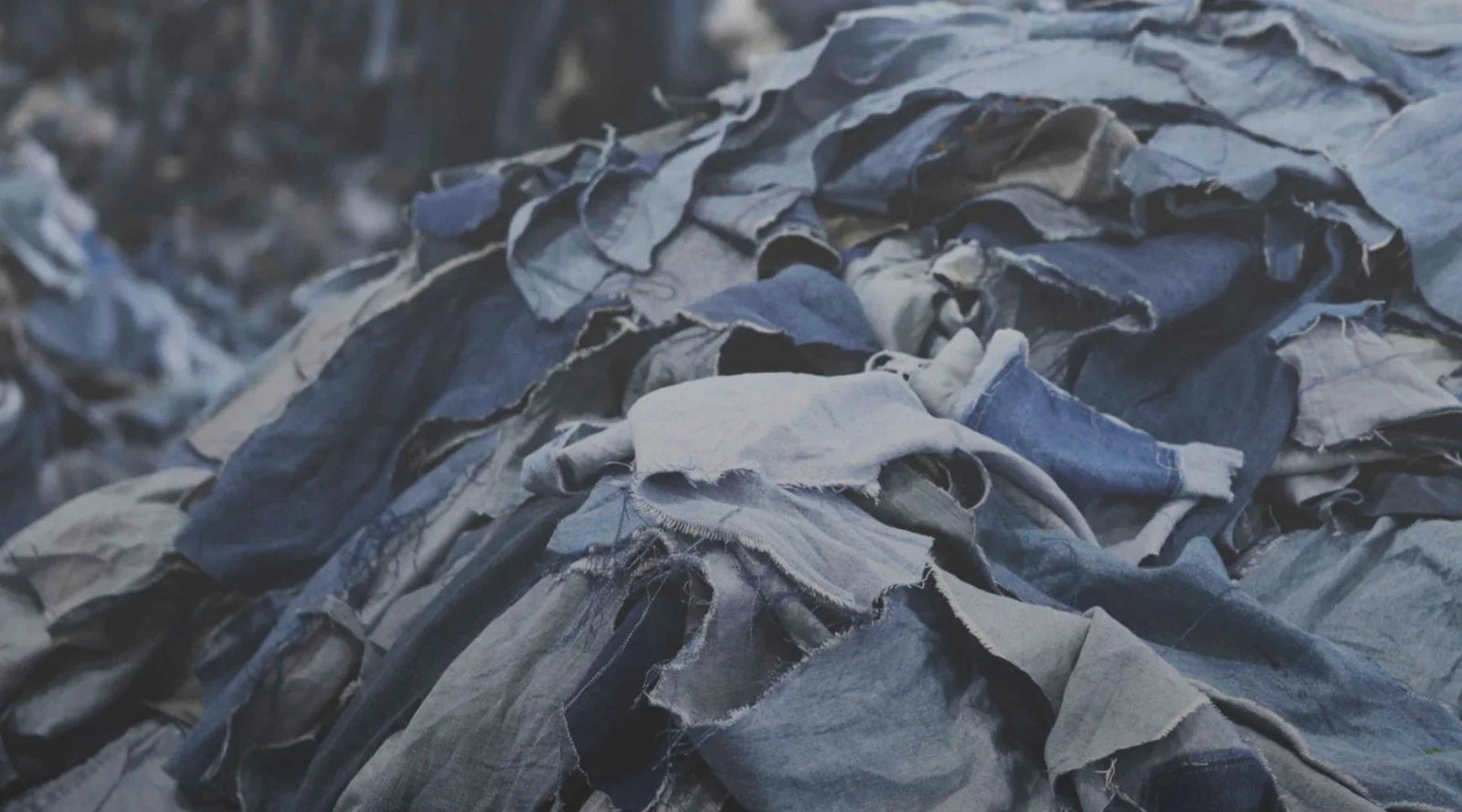
The pile is real.
Our partner Bank & Vogue operates Beyond Retro, the largest vintage retailer in the UK and Nordics. Their sorters move through 93 million pounds of secondhand clothing every year to keep their stores stocked. They are, by necessity, extremely picky — only about 1 in 1,000 items makes it to a shop floor. The rest gets routed: some to recycling, some to wholesale, and some — the denim that's structurally sound but doesn't fit what a vintage store needs — to their remanufacturing facility.
This is what the industry calls post-consumer denim. It's not scraps from a factory floor. It's clothing that real people wore and donated in good faith, that the system simply couldn't find a home for. The cotton is intact. The weave is solid. The indigo is still doing its thing. It just needed someone to look at it differently.
From donor jeans to kid-sized jacket.
 Photo courtesy of Bank & Vogue.
Once the denim is sorted and selected, it travels to Beyond Remade — Bank & Vogue's circular manufacturing facility in western India. The location is deliberate: it sits alongside one of the world's major secondhand sorting hubs, which means the fabric doesn't travel far between sort and cut.
The factory is independently audited against rigorous international labor and environmental standards — covering workers' rights, safe conditions, environmental practices, and business ethics. The team there has spent years working out the specific challenges of cutting from post-consumer material rather than bolts of new fabric: how to get a consistent pattern piece from a trouser leg, how to work around wear points, how to keep waste near zero by looping anything that doesn't pass back into the sorting stream.
The environmental math is striking. According to an independent lifecycle assessment, manufacturing with post-consumer denim like this uses up to 98% less water and produces up to 80% lower carbon emissions than making new denim from scratch. That's not a marketing claim — it's a measured comparison against the conventional alternative.
What Broken In actually is.
 Photo courtesy of Bank & Vogue.
Every piece in the Broken In collection starts as someone's discarded jeans. Bank & Vogue sorts by weight, color, and condition. Their cutters work carefully around the wear points and idiosyncrasies of each piece of reclaimed fabric. Their sewers, working in a facility where fair treatment isn't a footnote but a requirement, turn what's left into something a kid can wear hard all over again. Scraps loop back into the sorting stream rather than hitting a bin.

Photo courtesy of Rebecca Drobis Photography
The result is kids' clothing that carries a little history in the fabric — the slight fade, the softness that only comes from actual wear, the knowledge that nothing new was grown or woven to make it. Each piece is one-of-a-kind in the way that only reclaimed material can be.
Eighty pounds a year, per person. We think it's time to put some of it back to work.
Early access opens May 20th for everyone on the waitlist. Join the waitlist ↓


Find your perfect pants
TAKE THE QUIZ
A few quick questions to point you in the right direction. Plus, get $10 off your next order.