FREE SHIPPING ON ALL US ORDERS OVER $150
May 18, 2026 3 min read
A few years ago, my husband had a pair of corduroy pants he absolutely loved. He'd worn them so much that the front of the thighs had gone smooth — the corduroy nap just worn away. I looked at him one day and said, pretty gently, "You can't wear those in public anymore."
He looked genuinely sad. "But they're so comfortable."
He was right. They were really comfortable. Most of the fabric was just fine, it was just the front. And then I realized, our son could wear those.
I took those cords, laid one of our early Jackalo patterns on top, and cut them down. I reused the waistband. The worn patch on the front was hidden by the reinforcement panel at the knee — which is exactly where kids need it anyway. We kept about 95% of that fabric in use. My husband got to grieve his pants and our son got a pair that were already perfectly soft.
That experience stuck with me. I kept thinking: when a grown-up is done with a garment — when it's stained, or worn through in one spot, or just doesn't fit anymore — how much of that fabric is still in perfect condition? The answer, almost always, is: a lot.
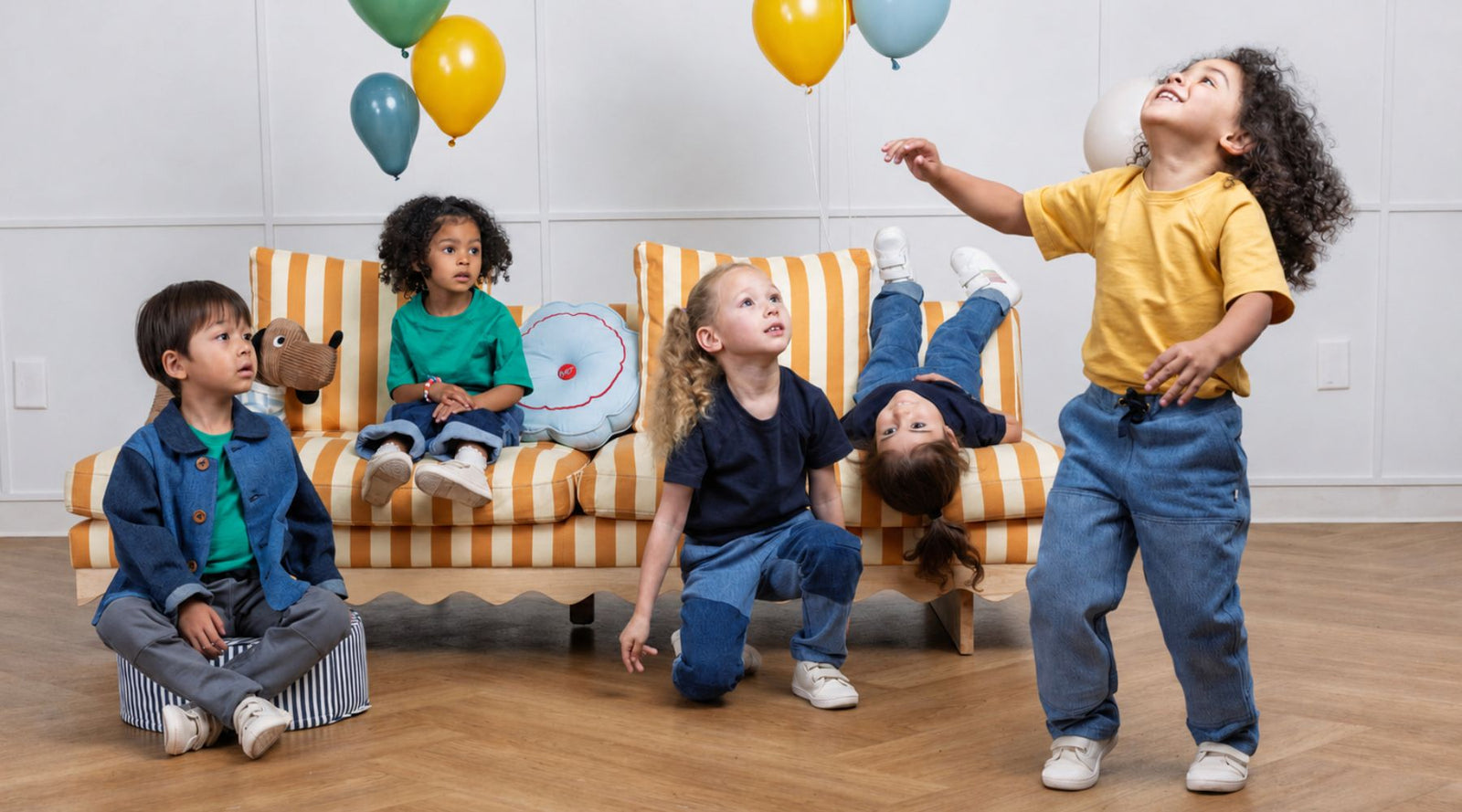
That's the idea behind our new Broken In collection.
Think about the last pair of jeans you donated. If they didn't sell at the thrift store, they got baled and shipped — most likely to India, where the majority of the world's secondhand clothing is sorted. From there, garments that can't be resold often go to downcycling facilities where they get turned into rags or insulation. But when you have the right partners, some get diverted to remanufacturing facilities.
That's where our Broken In collection begins.
We partnered with Bank & Vogue, a large resale operator in the UK and Scandinavia with a remanufacturing facility in India. Their team sources grade-B denim — the jeans that didn't make the cut for resale — washes everything, cuts away the seams and waistbands, and produces usable panels of fabric. Then they work with us to cut those panels into kids' clothes using our existing Jackalo patterns.
We pushed the post-consumer material as far as it could go. Even the pocket linings are made from upcycled shirting. The energy inputs are significantly lower than producing new fabric. The water inputs are a fraction of what conventional denim manufacturing requires.
And the best part is, grown-up already did the hard work of breaking them in.
Anyone who has tried to get a kid into a stiff new pair of jeans knows what I'm talking about. Denim takes time to soften. It can feel scratchy at first, especially for kids who are sensitive to texture. A lot of kids just refuse to wear them until they've been washed a dozen times.
With Broken In, that problem is solved before the jeans ever arrive at your door. A grown-up wore these and washed them until they were perfectly soft. Now your kid gets to skip straight to the good part.
When I fit-tested the first samples, I asked an eight-year-old to wear them for a few days and tell me what she thought. Her main feedback was: can I keep these?
One of the things that bothers me most about the conventional denim industry is the lengths it goes to to simulate wear. Acid washing. Sandblasting. Pre-ripping in nine places. Chemicals to make fabric look lived-in.
Broken In jeans look the way they do because they were lived in. Every variation in the fabric is real. Every soft spot earned. That's not a marketing line — it's just what happens when real people wear real clothes.
The Broken In collection launches publicly on May 22nd — and a little early for our subscriber list on the 20th. These are limited run.
If you've been looking for kids' jeans that are already soft, already broken in, and made in a way that actually makes sense — this is them. Plus, they've got a pretty amazing story behind them.
Find your perfect pants
A few quick questions to point you in the right direction. Plus, get $10 off your next order.